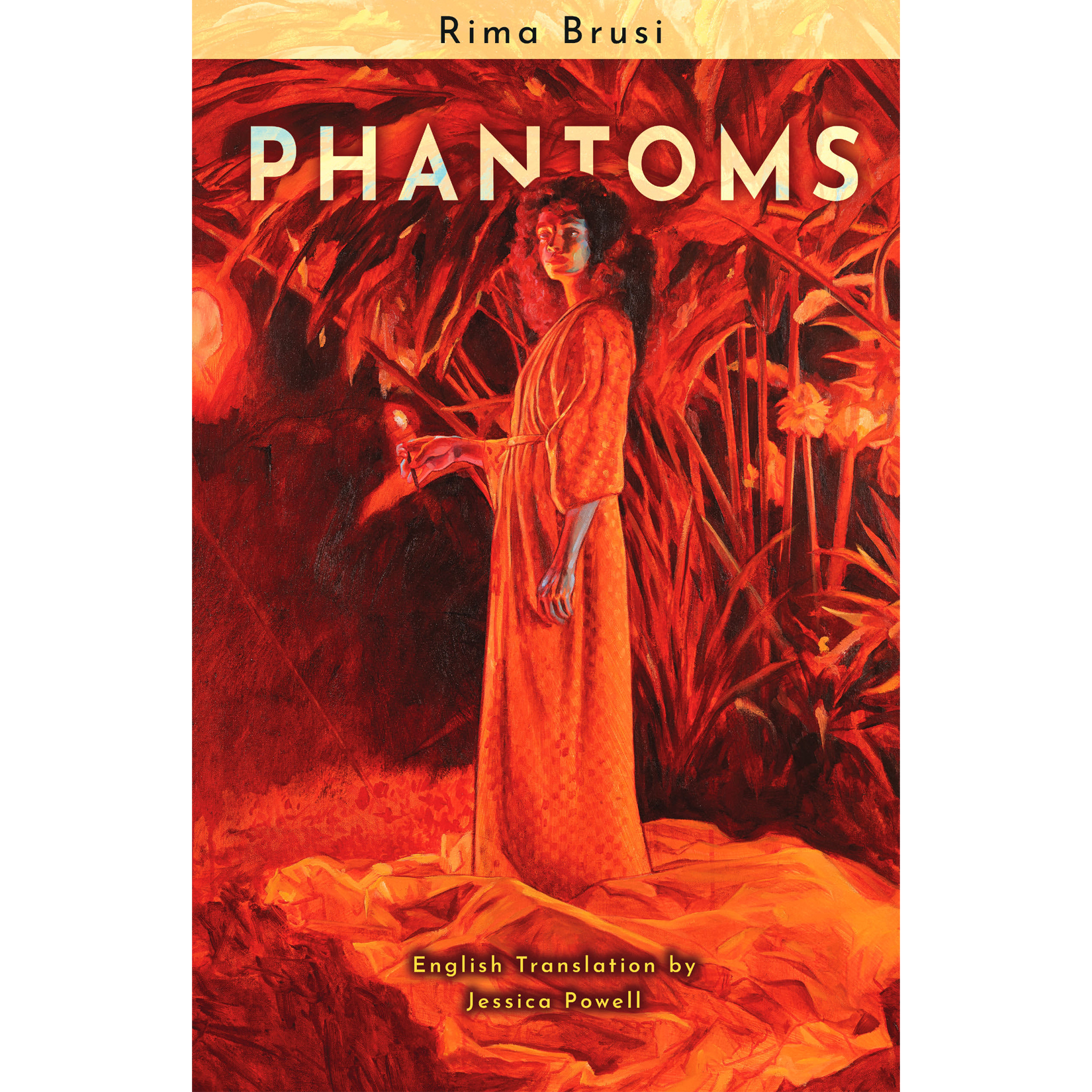
Phantoms begins with a literal phantom: an olfactory hallucination that Rima follows for years while she writes an intimate memoir of motherhood, memory and mind. The book traces four generations of women: a great-grandmother with a cigar, a flask of rum and a deck of cards; a grandmother of formidable intellect and early death; another, strict and secretive, who raises the author; and, most present and least understood, the strange and estranged mother—luminous, wounding, timid, playful—who becomes an obsession.
Real-life scenes unfold through time: a village scandal, untreated mental illness, a rock festival, an acid trip, a Santería initiation. Rima’s motherhood, writing and language are inseparable from her lineage, her island and the diaspora that pulled her away.
The result is a narrative archaeology of the self that binds the spectral and the material, with a voice that moves between memory and inquiry, grief and humor, rendered with lyrical precision.
The English translation by Jessica Powell preserves voice, meaning and cadence, and includes two new chapters written by the author.
RIMA BRUSI is a Puerto Rican writer and scholar whose work moves between creative nonfiction, ethnography and applied research. Her book Fantasmas (Editora Educación Emergente, 2019) won a PEN Puerto Rico Premio Nacional in 2020. She lives in Flagstaff, Arizona.
JESSICA POWELL is the translator of Pedro Cabiya’s Reinbou (Astra House, 2024), Sergio Missana’s The Transentients (McPherson & Co., 2021) and Gabriela Wiener’s Nine Moons (Restless Books, 2020) a Kirkus Best Nonfiction pick. She received a 2011 NEA Translation Fellowship for Antonio Benítez Rojo’s Woman in Battle Dress, later a PEN Center USA finalist. Her translation of Cabiya’s Wicked Weeds was a finalist for the 2017 Best Translated Book Award. Other projects include Pablo Neruda’s Venture of the Infinite Man and co-translations of works by Adolfo Bioy Casares and Silvina Ocampo.
“Rima Brusi is a consummate storyteller. In Phantoms, she recounts the stories of several generations of Puerto Rican women in her family, exploring memory, motherhood, writing, absence and trauma in an unsentimental, lucid voice that is at once personable and incisive, demanding yet empathetic. Echoing Luis Rafael Sánchez’s classic essay, “¿Por qué escribe usted?” (Why do you write?), Brusi’s finest work of autoethnography suggests that writing—and its close companion, reading—are vital tools for making sense of chaos, anger, happiness and remembrance. Tender and sharp, it showcases the very best of contemporary Puerto Rican literature.
Translator Jessica Powell does a formidable job capturing Brusi’s playful engagement with language and her insistence on finding exactly the right words.”
—Félix V. Matos Rodríguez, chancellor of The City University of New York (CUNY), author of Women in San Juan, 1820-1868 and editor of A Nation of Women: An Early Feminist Speaks Out
“A book of rare intelligence and great emotional delicacy: a constellation of intimate stories and essays in which Brusi turns fractured memory, motherhood, the body, illness and affective inheritance into a work of remarkable lucidity and beauty. With prose that is elegant, incisive and profoundly human, she explores the phantoms of the mother, childhood and the self without ever lapsing into sentimentality or self-pity. The result is an engrossing, original and moving book, written by an author capable of thinking with rigor, remembering with courage and transforming experience into true literature.”
—Pedro Cabiya, author of Reinbou and Wicked Weeds: A Zombie Novel
“Reading this book is a physical experience, not only because of the clarity, rhythm and beauty of its narrative voice, but because the author writes with her whole body, feeling every abstract word until it becomes alive. In a world obsessed with outcomes over process, Brusi offers a gift to the reader: a meditation on what it means to share our piece of the collective memory and on writing itself as an ethics both for life and for art. Not every day you read a book that stays inside you as a happening to the soul.
—Ana Teresa Toro, author of Secuestro Pulmonar and El cuerpo de la abuela: Una oda a la memoria; columnist for El País
“A different yet equally moving experience from its Spanish incarnation, Fantasmas. With two additional essays, the aptly named Phantoms attends both to things that are present in some spectral form and to those that were once there but no longer are. Brusi is a stellar writer with a meticulous way of choosing exactly the right word to convey a feeling, an idea, a sensibility. This is a must read for anyone who values thoughtful, real life storytelling.”
—Carmen R. Lugo-Lugo, professor of Comparative Ethnic Studies, Washington State University Vancouver, and co-author of Feminism after 9/11: Women’s Bodies as Cultural and Political Threat
“A gorgeously written memoir, Phantoms is a soul-searching exploration of motherhood, abandonment and spirituality with a peek into 1970’s Puerto Rico. Rima Brusi’s deeply personal work sits alongside Esmeralda Santiago’s When I was Puerto Rican as a seminal Caribbean piece of art. Searing and poetic, Phantoms is a must read!”
– Lilliam Rivera, author of Tiny Threads
“Brusi takes you on a path of the ‘abecedary’ of memory and forgetting, poetically connecting the fissure of taboos and norms by breaking generational histories of silence in Phantoms. Poignant, entertaining, sometimes shocking, but always seeking the truth of her experiences, she shares raw glimpses of private childhood spaces closed to outsiders from the hunger of poverty and clogged toilets in Puerto Rican public schools to a cultish marijuana community in Colombia, to Santeria initiation back on the island to the multiple childhood abandonments that happened in tandem. An ethnographer of her own life, she follows the scent that drives her to write and remember and gives the reader the gift of taking us along on her clear-eyed journey to make sense of who she is and where she comes from. A tour de force.”
–Victoria Sanford, author of Buried Secrets: Truth and Human Rights in Guatemala and Textures of Terror: The Murder of Claudina Isabel Velasquez & Her Father’s Quest for Justice